Why the Fed's decisions land in Abu Dhabi
The dirham has been fixed to the dollar since 1997. That single choice turns every Federal Reserve decision into a local event, right down to the monthly repayment on a UAE home loan.
On 16 September the Federal Reserve raised its policy rate for the first time in more than three years, by 25 basis points to a range of 3.75% to 4.00%. Within hours, the Central Bank of the UAE raised its Base Rate by the same amount, to 3.90%. Nobody in Abu Dhabi was surprised, and that absence of surprise is precisely the subject of this briefing.
Context: a currency fixed since 1997
The dirham has been fixed at 3.6725 to the US dollar since 1997. Five of the six Gulf Cooperation Council currencies are pegged to the dollar in the same way, while Kuwait manages its dinar against an undisclosed basket. For a small, open economy whose principal export is priced in dollars, the arrangement makes sense: it takes exchange-rate risk out of trade, out of hydrocarbon revenue and out of the investment decisions of anyone holding dirham assets.
The peg has a price, however, and that price is paid in interest rates.
Framework: two out of three
The Mundell-Fleming model gives the clearest account of why. An open economy can choose any two of three things, a fixed exchange rate, free movement of capital and an independent monetary policy, but it cannot hold all three at once. The UAE has chosen the first two. With capital free to move and the dirham fixed, any lasting gap between UAE and US interest rates would draw money towards whichever currency paid more, and the central bank would have to spend reserves in defending the peg.
The CBUAE closes that gap by design. Its Base Rate is anchored to the Federal Reserve's interest rate on reserve balances, so when the Fed moves, the Base Rate moves with it. In practice, the UAE keeps its interest rates in step with US rates by choice rather than by circumstance, and a stable dirham is the return on that choice.
Evidence: eighteen decisions, matched one for one
The chart below plots every policy decision since December 2020. Across the 18 rate changes in that period, the CBUAE moved on the same day as the Fed, by the same amount and in the same direction, while the gap between the Fed's upper bound and the Base Rate held at 10 basis points throughout.
The 2022 to 2023 tightening cycle is the clearest test. The Fed raised rates by 525 basis points to bring US inflation back towards target. The UAE's inflation position was not the same, yet the Base Rate rose by exactly 525 basis points as well, from 0.15% to 5.40%. The discipline held on the way down too: three cuts in late 2024 and three more in late 2025, each one matched. September's increase was simply the most recent instance.
Interpretation: a price worth paying
It would be easy to read this as a constraint; however, that reading overlooks what the UAE receives in return. A credible peg removes a whole category of risk that other emerging markets carry. There is no currency crisis to price and no devaluation to hedge, and dollar-based investors can treat dirham cash flows much as they treat dollar cash flows. For an economy that wants to attract patient, long-term foreign capital, that credibility is worth a great deal.
What changes is where the work of domestic stabilization is done. With the interest rate committed, fiscal policy, liquidity management through instruments such as the CBUAE's Monetary Bills, and macro-prudential rules on lending carry more of the load. The Base Rate sets the price of money, while the other levers decide how much of it reaches the economy, and where.
Implication: from a Fed decision to a monthly repayment
A restrictive monetary policy works by making money more expensive. Higher rates raise the cost of borrowing and the reward for saving, which in practice cools credit-financed spending on homes, cars and other large purchases, and with it the pressure on prices. In the United States the brake was visible: real spending on durable goods, such as cars and furniture, fell by about 2.3% in 2022 as the Fed raised rates, after two years of strong growth.
The UAE imported the same tightening for a different reason, the peg rather than domestic overheating, yet the timing proved helpful. Inflation, which had reached 5.3% in 2022 as global energy and food prices surged, fell back to 1.6% in 2023 and has stayed below 2% since. Higher rates were one reason among several, alongside the easing of global commodity prices; however, the direction was the one a restrictive policy aims for, while non-oil activity kept growing at around 6% in 2023.
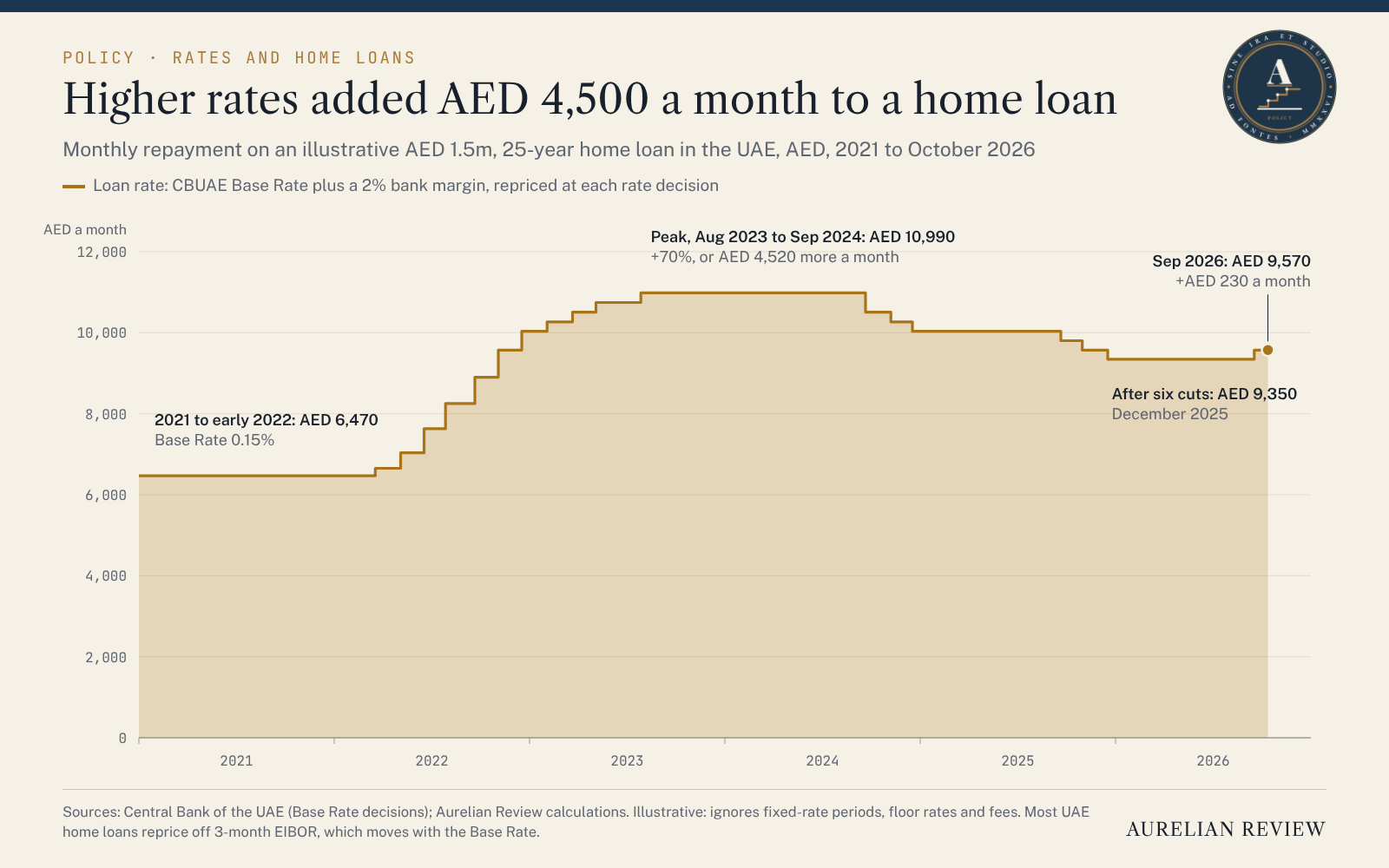
For households, the channel that matters most is the home loan. Most UAE mortgages carry a fixed rate for the first one to five years and then reprice at three-month EIBOR plus a bank margin, typically between 1.5% and 2.5%, and EIBOR itself moves with the Base Rate. Applying the Base Rate path to an illustrative AED 1.5m, 25-year loan at a 2% margin, the monthly repayment rose from about AED 6,470 in early 2022 to AED 10,990 at the peak, an increase of 70%, or AED 4,520 a month. Six cuts brought it back to AED 9,350, and September's increase added around AED 230. Borrowers still inside a fixed-rate period were shielded from the rise, although only until that period ended.
The Central Bank's mortgage rules limited how much of that shock households could take on in the first place. A loan on a first home worth up to AED 5m may not exceed 85% of the property's value for UAE nationals and 80% for expatriates, total debt repayments are capped at 50% of income, and terms are limited to 25 years. In practice, these limits act as a buffer: higher repayments squeeze household budgets, but borrowers start with equity in the property and room in their income, which keeps the strain away from the banking system.
Sources
Board of Governors of the Federal Reserve System, FOMC statements, 2020 to 2026.
Central Bank of the UAE, Base Rate announcements, 2020 to 2026.
Central Bank of the UAE, Regulations regarding Mortgage Loans (Circular 31/2013), as amended by Board Resolution 31/2/2020.
World Bank, consumer price inflation for the United Arab Emirates, via FRED (series FPCPITOTLZGARE).
US Bureau of Economic Analysis, real personal consumption expenditures on durable goods, via FRED (series PCEDGC96).
Federal Competitiveness and Statistics Centre, GDP estimates for 2023, as reported by Reuters, May 2024.
International Monetary Fund, United Arab Emirates: Article IV consultation staff reports.
Mundell, R. A. (1963) 'Capital mobility and stabilization policy under fixed and flexible exchange rates', Canadian Journal of Economics and Political Science, 29(4), pp. 475 to 485.